
Vision: your secret weapon
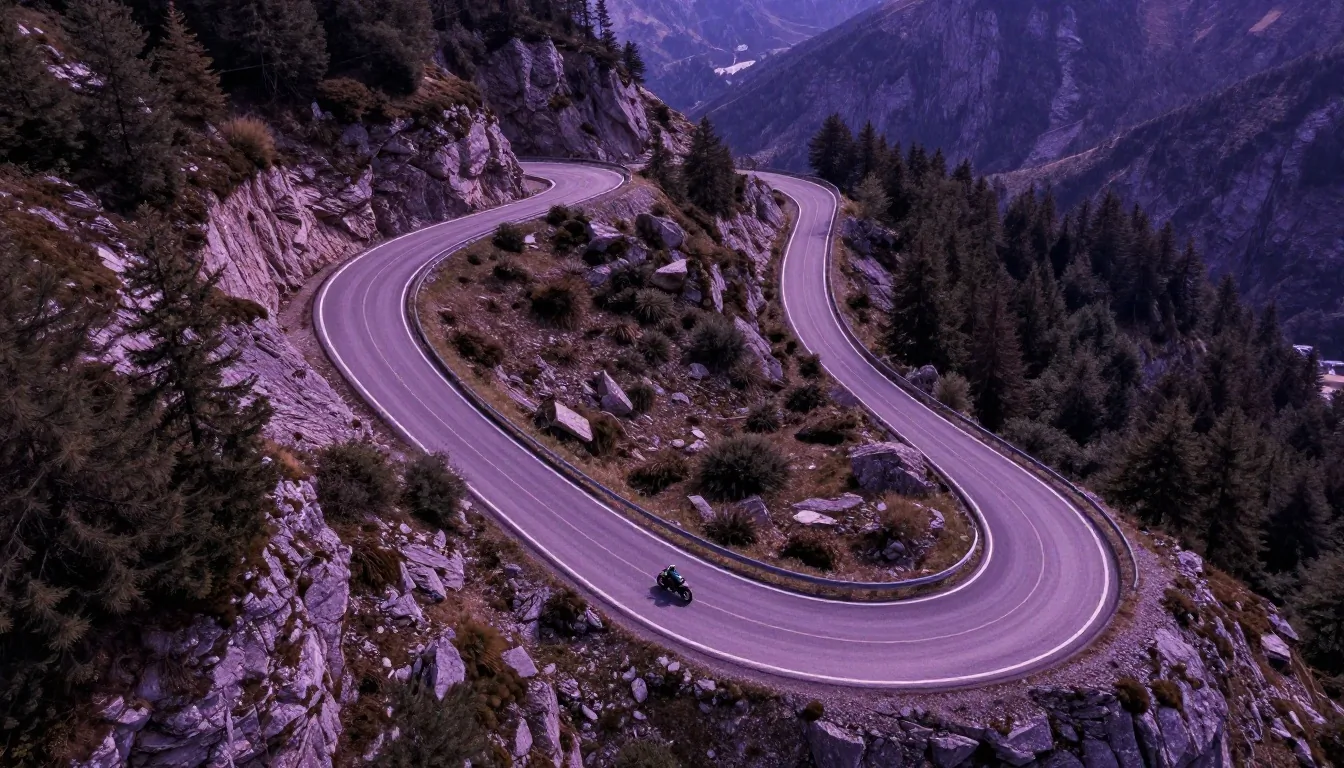
On a motorcycle, you go where you look. It's a law of physics and neurology combined. In a hairpin, your instinct pushes you to look at the edge of the road, the cliff, or the stone wall — exactly where you do NOT want to go.
The technique is simple but counter-intuitive: turn your head and look at the exit of the corner. Not the entry, not the middle — the exit. Your motorcycle will follow your gaze like a magnet. This is the most important tip in this article, and the one with the biggest immediate impact on your riding.
Practice exercise: in an empty parking lot, trace an imaginary circle and ride around it while always looking at a point far ahead on the circle. You'll immediately feel the difference compared to a gaze fixed 2 meters in front of your wheel.
Body position: lean into the corner
In a hairpin, your position on the bike directly influences your turning radius and stability. There are three approaches:
Lean (body with the bike): Your body stays aligned with the motorcycle. It's the natural position for beginners. It works for open corners but limits lean angle in tight hairpins.
Hang off (body to the inside): You shift your weight to the inside of the corner by sliding one cheek off the seat and dropping the inside knee. The bike needs to lean less for the same radius, increasing your safety margin. It's the technique of track riders, adapted for the road.
Counter-lean (body to the outside): Used only at very low speed in ultra-tight corners (parking maneuvers, U-turns). Your body stays upright or leans outward while the bike leans heavily. Very useful in the tightest hairpins of alpine passes.

Throttle control: maintain a constant whisper of gas
This is probably the hardest technique for beginners to master. In a hairpin, the throttle must be managed with surgical precision:
Before the corner: Brake in a straight line, BEFORE you start turning. All your deceleration must be done before entering the corner. Arrive at the turn-in point at the right speed.
In the corner: Maintain a constant, light whisper of throttle. Never fully close the throttle in a corner — this compresses the front suspension, reduces rear tire grip, and destabilizes the bike. Even the tiniest whisper of throttle keeps the chain tensioned and the bike stable.
On exit: Accelerate progressively as soon as you see the exit of the corner and start straightening up. Roll-on must be smooth and progressive — never brutal, especially on wet roads or gravel.
Line: outside-inside-outside
The ideal line through a hairpin follows the «outside-inside-outside» principle:
- Entry (outside): Position yourself on the outside of your lane. This gives you better visibility through the corner and a more open angle of attack.
- Apex (inside): Aim for the apex — the innermost point of your line — at the middle or slightly past the middle of the corner. That's where you start to straighten the bike.
- Exit (outside): Let the bike drift naturally back to the outside of the lane as you accelerate progressively.
Important: On open roads, ALWAYS stay in your lane. The «outside-inside-outside» line is taken within the limits of your own lane. Cutting a corner across the centerline risks a head-on collision with oncoming traffic.
The mistakes that cause crashes
Crashes in hairpins almost always have the same causes:
- Braking in the corner: The classic number one mistake. Braking mid-corner compresses the front suspension, reduces turn radius, and can lock the front wheel on gravel. Solution: brake BEFORE the corner, not in it.
- Entering too fast: If you arrive too fast in a hairpin, your instinct says to brake (see mistake above). Solution: slow down more than necessary before entry. It's always easier to accelerate on exit than to brake mid-corner.
- Looking at the ground: Eyes fixed 2 meters ahead of your front wheel will pull you to the inside and tip you over. Lift your head and look at the exit.
- Tensing up: Stiff arms and tense shoulders prevent the bike from turning naturally. Relax your grip on the bars — the bike WANTS to turn, let it.
- Snapping the throttle shut: Closing the throttle mid-corner destabilizes the bike. Always keep a whisper of gas, however small.
Building confidence progressively
Confidence in corners is built gradually. Here's how to progress without risk:
- Start with open corners: The big sweeping curves of countryside roads before the mountain hairpins.
- Empty parking lot: Trace circles of decreasing size. Work on vision, position, and throttle whisper.
- Easy mountain pass: Start with low-elevation passes with wide hairpins (Galibier from the Lautaret side, for example).
- Riding course: A one-day course with a professional instructor is worth months of self-taught practice. It's the highest-ROI investment to progress quickly.
With Vroom GPS, the «Thrilling» profile takes you on the most winding roads — perfect for putting these techniques into practice. And voice navigation lets you focus on your riding rather than the route.
Ready to Ride with a Real Motorcycle GPS?
Download Vroom GPS for free and discover roads you never knew existed.

